pva knowledge
Application of PVA in Activated Carbon
As a highly efficient adsorbent material, activated carbon is widely used in water treatment, air purification, food decolorization, pharmaceutical purification and many other fields. In the preparation and application of activated carbon, the choice of binder plays a decisive role in the molding quality, adsorption performance and mechanical strength of the final product. PVA (Polyvinyl Alcohol), a water-soluble polymer, occupies an important position in the molding process of activated carbon owing to its excellent film-forming ability, binding strength and chemical stability. This article systematically introduces the application principles, technical advantages and key process parameters of PVA in activated carbon.
Basic Properties of PVA and Their Relationship with Activated Carbon Preparation
PVA is a water-soluble polymer obtained by saponification of polyvinyl acetate. Its molecular structure contains a large number of hydroxyl groups (-OH), which endow PVA with strong hydrophilicity and the ability to form hydrogen bonds. During activated carbon preparation, PVA primarily serves as a binder and molding aid. The hydroxyl groups on the PVA molecular chains form hydrogen bonds with the oxygen-containing functional groups on the activated carbon surface, thereby achieving an efficient binding effect.
The polymerization degree and hydrolysis degree of PVA are the two core parameters affecting its performance in activated carbon applications. The polymerization degree determines the length of the PVA molecular chain and the viscosity of the solution, while the hydrolysis degree affects its water solubility and film-forming performance. In activated carbon molding processes, PVA with a medium polymerization degree (around 1700) and a fully hydrolyzed type (hydrolysis degree 98%-99%) is typically selected to balance binding strength and process operability.
Core Application of PVA in Activated Carbon
Activated Carbon Molding Binder
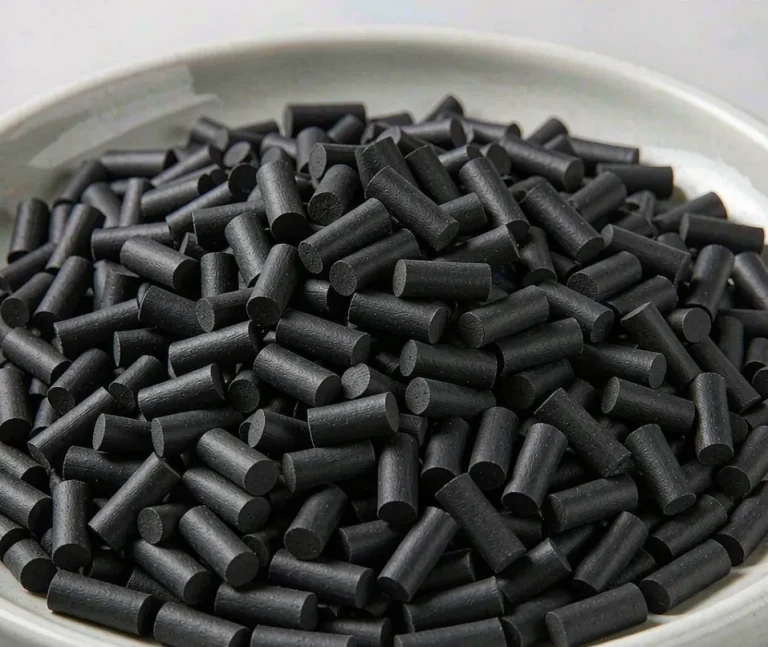
In the extrusion molding process of columnar activated carbon and granular activated carbon, PVA plays an irreplaceable role as a binder. After dissolving PVA into an aqueous solution of a certain concentration and mixing it with raw materials such as coal powder, wood powder or nut-shell powder, the PVA solution evenly wets the surface of the carbon powder particles. After extrusion molding, carbon columns with good mechanical strength are formed. Following drying and activation treatment, PVA partially decomposes at high temperature, forming additional pore structures that help improve the specific surface area and adsorption capacity of the activated carbon.
Compared with traditional coal-tar binders, PVA offers significant advantages including environmental friendliness, non-toxicity, low operating temperature and stable molding quality. Although coal-tar binders possess strong binding force, they contain a large amount of hazardous substances such as polycyclic aromatic hydrocarbons, posing environmental pollution and health risks during production and subsequent use. As a water-based binder, PVA completely avoids this problem and aligns with the current trend of green manufacturing.
Spinning Auxiliary for Activated Carbon Fibers
In the preparation of activated carbon fibers, PVA can be used as a spinning auxiliary. By blending PVA with precursors such as phenolic resin or pitch, and preparing the precursor fibers through wet or dry spinning, activated carbon fibers are obtained after pre-oxidation and carbonization activation. The addition of PVA improves the rheological properties of the spinning solution, enhances the strength and uniformity of the precursor fibers, and the carbon residue formed by PVA during carbonization increases the carbon yield of the activated carbon fibers.
Activated Carbon Composite Membrane Materials
PVA and activated carbon powder can be compounded to prepare thin-film materials for water treatment and gas separation applications. By mixing the PVA aqueous solution with activated carbon powder in a certain proportion, coating it on a substrate and drying it into a film, the PVA matrix provides good film-forming ability and mechanical strength, while the dispersed activated carbon particles provide adsorption functionality. This composite membrane material combines the flexibility of polymer membranes with the adsorption capacity of activated carbon, showing application potential in industrial wastewater deep treatment and indoor air purification.
Activated Carbon Surface Modification
PVA can also be used for the surface modification of activated carbon. By impregnating activated carbon in a dilute PVA solution, PVA molecules can adsorb on the activated carbon surface, introducing a large number of hydroxyl functional groups and thereby changing the surface chemical properties of the activated carbon. PVA-modified activated carbon shows significantly improved adsorption capacity for polar pollutants such as heavy metal ions and dye molecules. Studies have shown that the adsorption capacity of PVA-modified activated carbon for copper ions can be increased by 30%-50% compared with unmodified activated carbon.
Application Fields of PVA Activated Carbon
Activated carbon products prepared with PVA as a binder or modifier demonstrate excellent application effects in multiple industrial fields. In the field of water treatment, PVA-molded activated carbon features high mechanical strength and wear resistance, capable of withstanding backwashing and hydraulic impact. It is suitable for fixed-bed adsorption columns and moving-bed adsorption devices, and can effectively remove organic pollutants, residual chlorine and odorous substances from water. In the field of air purification, PVA-composite activated carbon membrane materials can be used for the adsorption and removal of harmful gases such as formaldehyde and benzene series in indoor air. Their flexible membrane morphology is suitable for making air purifier filter elements and wall-attached materials.
In the food industry, PVA-bonded activated carbon does not contain hazardous residues such as coal tar and meets the safety requirements for food-grade materials. It can be used in processes such as sugar decolorization, edible oil refining and liquor purification. In the pharmaceutical field, PVA-modified activated carbon, rich in surface functional groups, has selective adsorption capacity for specific drug molecules and biological toxins, and can be used for medical purposes such as hemoperfusion and drug detoxification.
Process Essentials of PVA in Activated Carbon Applications
The concentration of the PVA solution is a key parameter affecting the molding quality of activated carbon. Generally, a PVA aqueous solution concentration of 8%-15% is appropriate. Too low a concentration leads to insufficient binding force and inadequate post-molding column strength; too high a concentration results in excessive solution viscosity, making it difficult to mix uniformly with carbon powder and affecting molding efficiency. The PVA dissolution process requires sufficient stirring and appropriate heating (80-95°C) to ensure complete dissolution without lumps.
The mixing ratio of PVA to carbon powder also requires strict control. Typically, the mass ratio of PVA solution to carbon powder is between 1:2 and 1:3, and the specific ratio should be adjusted according to the particle size distribution of the carbon powder and the target product strength. High-efficiency kneading equipment should be used during mixing to ensure the PVA solution evenly wets every carbon powder particle. The molded wet carbon columns need gradient drying (low temperature first, then high temperature) to avoid cracks and deformation caused by rapid drying.
Conclusion
PVA plays multiple roles in the preparation and application of activated carbon — as a binder, spinning auxiliary, composite membrane matrix and surface modifier. Its advantages of environmental friendliness, non-toxicity, strong binding force, good film-forming ability and high tunability make it an irreplaceable material in the activated carbon industry. With increasingly stringent environmental regulations and the continuous expansion of activated carbon application fields, the application of PVA in activated carbon will become even broader. Particularly in high-end products such as food-grade activated carbon, medical activated carbon and high-performance activated carbon fibers, the technical value of PVA will be further highlighted.