pva knowledge
PVA as a Binder in Activated Carbon Production
Activated carbon is manufactured by the carbonization and activation of carbonaceous precursors such as coal, wood, coconut shell or pitch. Whether the final product is a column, a granule or a fibre, its mechanical integrity — the ability to survive handling, backwashing and use — depends heavily on the binder that holds the particles together. PVA (polyvinyl alcohol), a water-soluble synthetic polymer, is increasingly chosen as a green, high-performance binder. This article covers why PVA works as a binder, its benefits, recommended dosage and the key process parameters for activated-carbon production.
Why PVA Works as a Binder
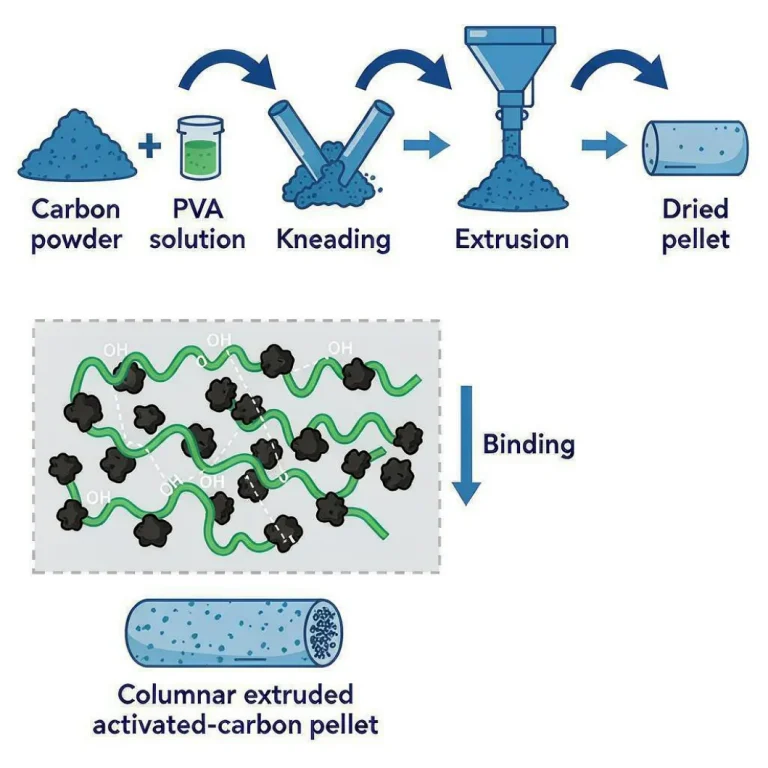
PVA molecular chains carry abundant hydroxyl (-OH) groups. During mixing, these hydroxyls form hydrogen bonds with the oxygen-containing functional groups on the carbon surface, producing strong interfacial adhesion between particles. After drying, the PVA film locks the particles into a coherent body; during high-temperature activation the PVA partly decomposes, and this decomposition additionally opens micropores that raise the specific surface area and adsorption capacity of the carbon.
Benefits Over Traditional Binders
Compared with coal-tar pitch — which is strong but toxic and laden with polycyclic aromatic hydrocarbons — PVA is non-toxic, water-based, operates at low temperature and is clean. Versus natural binders such as starch or CMC, PVA gives higher wet strength, better water resistance in fully hydrolyzed grades, and more consistent quality from batch to batch. Critically, PVA leaves no hazardous residue, which is essential for food-grade and medical-grade activated carbon.
Choosing the Right Grade
PVA 1799 (polymerization degree about 1700, hydrolysis 99–100 percent) is the workhorse for columnar and granular carbon: it delivers high binding strength and good wear resistance. PVA 124 (polymerization degree about 1200) suits fine powder composites where dispersibility matters more than peak strength. PVA 1788 (hydrolysis about 88 percent) is preferred for composite membranes that need flexibility and film transparency, thanks to its lower crystallinity.
Dosage Recommendations
Prepare a PVA aqueous solution at 8–15 percent by mass. Too low a concentration gives insufficient binding force and weak pellets after molding; too high makes the solution excessively viscous and hard to mix uniformly with carbon powder. The mass ratio of PVA solution to carbon powder is typically 1:2 to 1:3, adjusted by the particle-size distribution of the powder and the target product strength. Always use a fresh solution, because long storage promotes gelation and property drift.
In practice, many plants begin with PVA 1799 at a 10 percent solution and a 1:2.5 ratio, then tune the values based on pellet crush strength and activation yield. Small laboratory extrusion tests reliably predict full-scale behavior, so a one-day pilot saves weeks of plant troubleshooting and wasted raw material.
Key Process Parameters
Dissolution: heat the water to 80–95°C with steady stirring until the solution is clear and lump-free; higher-DP grades need the upper part of that range. Kneading: use a high-shear mixer so the PVA solution uniformly wets every carbon particle. Extrusion: form the wet columns or pellets. Drying: apply a gradient (low temperature first, then high) to avoid cracks and deformation from rapid drying. Activation: steam or CO2 at 600–900°C; the carbon residue from PVA contributes to the final porosity.
Application Fields
PVA bonded carbon performs well across industries: fixed-bed and moving-bed water-treatment columns that must withstand backwashing; air-purification composite membranes; food decolorization such as sugar and edible-oil refining; and pharmaceutical uses such as hemoperfusion, where cleanliness and selective adsorption both matter.
Conclusion
PVA turns activated-carbon molding into a cleaner, more controllable process. With the right grade, an 8–15 percent solution, a 1:2 to 1:3 mixing ratio and gradient drying, producers obtain strong, uniform and environmentally friendly products. Validate the combination on a pilot scale before committing to full production.