pva knowledge
PVA vs Other Binders in Activated Carbon Manufacturing
Activated carbon is only as good as the binder that holds it together. The binder determines the green strength of the extruded body, the wear resistance of the finished granule, the pore structure after activation and, increasingly, whether the product can be sold into food and medical markets. Four binders dominate the industry: coal tar pitch, starch, carboxymethyl cellulose (CMC) and polyvinyl alcohol (PVA). Each has a different balance of strength, water resistance, cost and safety. This article compares them on the criteria that matter in production.
The Role of a Binder
A binder has to do three jobs: wet the carbon particles and hold them in a uniform mix, give the extruded or pressed body enough green strength to survive handling, and leave a structure that activation can develop into useful porosity. A good binder does this at low dosage, without blocking pores, and without introducing hazardous residues. No single binder is best on all counts, which is why the choice depends on the product and the market.
PVA vs Other Binders in Activated Carbon
Coal Tar Pitch
Coal tar pitch is the traditional binder for high-strength carbon. It gives excellent green strength and wear resistance and contributes carbon to the structure during carbonization. Its weaknesses are serious: it is toxic, contains polycyclic aromatic hydrocarbons, requires high-temperature mixing and carbonization, and leaves residues that make the product unsuitable for food or medical use. Environmental and worker-safety regulations are making pitch increasingly expensive to handle. It remains the choice where maximum mechanical strength matters more than cleanliness.
Starch
Starch is cheap, non-toxic and widely available. It binds through gelatinization when heated in water and gives acceptable green strength for some granular products. Its weaknesses are water sensitivity and low wet strength: starch-bonded carbon softens in humid conditions and can lose strength during backwashing. It also burns out early during activation, leaving less carbon residue. Starch is a reasonable choice for low-cost, short-life products, but it struggles where durability and water resistance are required.
CMC
Carboxymethyl cellulose is a water-soluble cellulose ether that gives good dispersion and smooth extrusion. It improves the plasticity of the mix and helps produce uniform pellets. Its binding strength is moderate, and its water resistance is limited unless it is crosslinked or combined with another binder. CMC is often used as a co-binder to improve extrusion rather than as the sole binder. Cost is moderate, and it is food-safe, which makes it attractive for some grades.
PVA
PVA is a water-soluble synthetic polymer with abundant hydroxyl groups. It binds through hydrogen bonding to the oxygen-containing groups on the carbon surface, giving high green strength and good wear resistance. Fully hydrolyzed grades such as PVA-1799 add water resistance that starch and CMC cannot match. PVA is non-toxic, formaldehyde-free and operates at moderate temperature, and it leaves no hazardous residue, so it suits food-grade and medical-grade carbon. Its main drawbacks are higher cost than starch and the need for careful dissolution to avoid lumps.
Head-to-Head Comparison
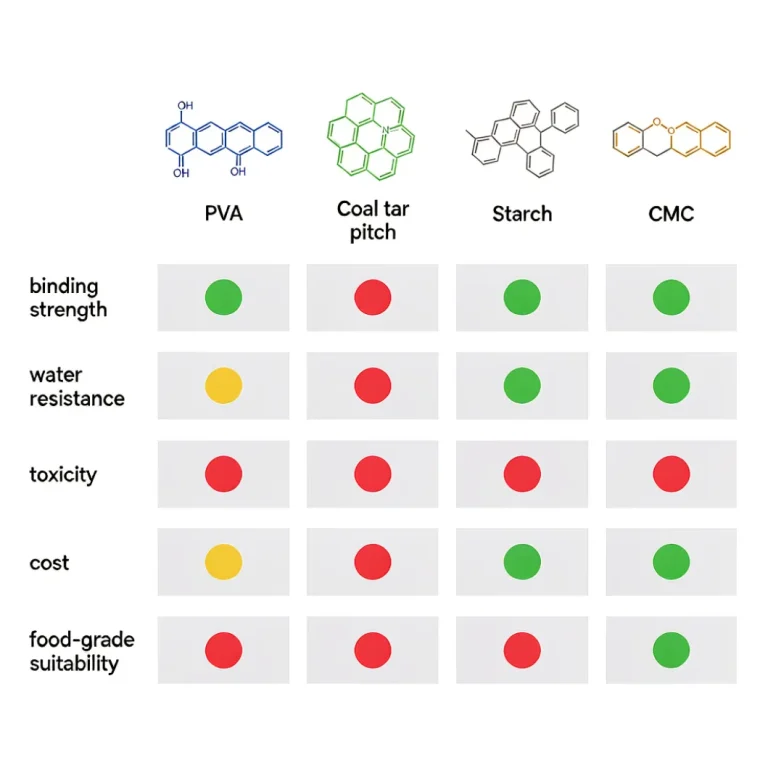
On binding strength, pitch is highest, PVA is close behind, and starch and CMC are moderate. On water resistance, fully hydrolyzed PVA leads; pitch is inherently water-resistant; starch is poor; CMC is limited. On safety, PVA, starch and CMC are all acceptable for food contact, while pitch is not. On cost per kilogram, starch is lowest, CMC and PVA are intermediate, and pitch is variable but carries high handling costs. On process complexity, starch and CMC are simple, PVA needs controlled dissolution, and pitch needs high-temperature mixing and carbonization. On pore structure, PVA and starch burn out cleanly, while pitch contributes carbon and changes the pore profile.
How to Choose
Choose pitch only when maximum mechanical strength is essential and the product will not touch food or the body. Choose starch for low-cost, short-life products where water resistance is not critical. Choose CMC as a co-binder to improve extrusion. Choose PVA when you need a combination of strength, water resistance, cleanliness and food-grade compliance. In most modern plants, PVA has become the default for water-treatment and food-grade carbon, with pitch retained for specialty high-strength applications.
Conclusion
There is no universal best binder. Pitch wins on strength, starch on cost, CMC on extrusion, and PVA on the balance of strength, water resistance and safety. Match the binder to the product and the market, and validate the choice on a pilot line before committing to full production.