
pva knowledge
Does PVA fully dissolve in water?
A top question for manufacturers, formulators, and product designers working with water-soluble polymers is: Does PVA fully dissolve in water? Polyvinyl Alcohol (PVA/PVOH) is a globally renowned water-soluble synthetic polymer used in soluble films, adhesives, textile sizing, paper coatings, and dry-mix construction materials. However, many users experience incomplete dissolution, residual particles, or cloudy solutions, leading to product defects and production confusion.
The short answer is: PVA can fully dissolve in water under specific temperature and processing conditions, but not all PVA grades dissolve completely in cold water. Full solubility depends primarily on the PVA hydrolysis degree, water temperature, particle size, and mixing method. This guide breaks down PVA dissolution rules, grade-specific solubility differences, common dissolution failures, and industrial best practices.
Why PVA Dissolves in Water
Unlike insoluble plastics such as PVC, PE, and PP, PVA features abundant hydrophilic hydroxyl (-OH) groups on its molecular chain. These groups form strong hydrogen bonds with water molecules, allowing the polymer chain to separate and disperse evenly in water at the molecular level.
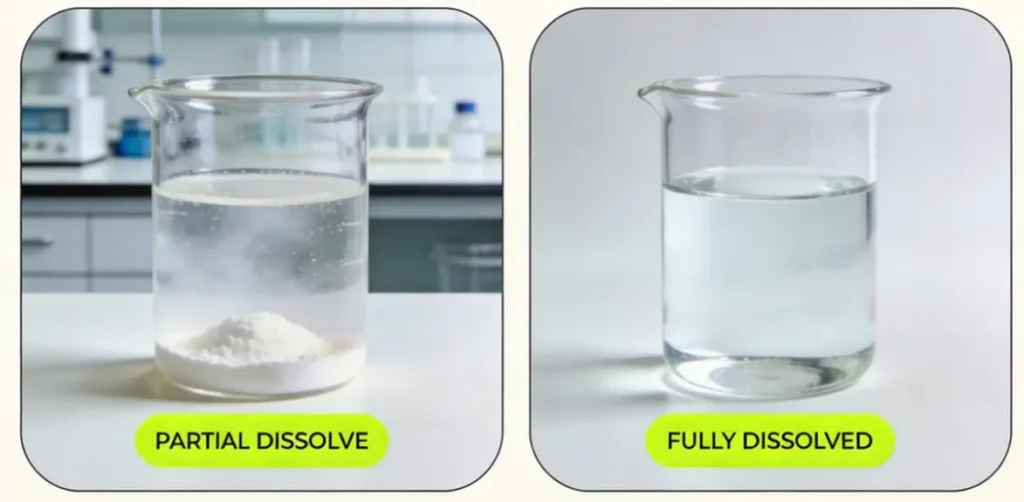
True full dissolution means PVA breaks down into individual molecular chains to form a transparent, homogeneous aqueous solution, with zero solid residues or micro-particles left behind. This molecular dissolution is the key reason why qualified PVA materials avoid microplastic formation in water environments.
A critical factor altering solubility: degree of hydrolysis. Different hydrolysis rates change PVA’s internal crystallinity and hydrogen bond density, creating completely different water-dissolving behaviors across grades.
Grade-by-Grade PVA Water Solubility Rules
Partially Hydrolyzed PVA (87–89% DH: 1788, 2488)
- Cold water (20–40°C): Fully dissolves slowly with continuous stirring.
- Warm water (40–60°C): Fast, complete dissolution with clear solution output
- No boiling required: Avoids overheating and solution foaming
Fully Hydrolyzed PVA (98–99% DH: 1799, 2499)
- Cold/room-temperature water: Only swells, cannot fully dissolve, leaves white solid residues
- Hot water (85–95°C): Complete dissolution after 30–60 minutes of constant stirring
- Strict temperature requirement: Fails to fully dissolve below 80°C
Why Does PVA Fail to Fully Dissolve?
- Grade-temperature mismatch: Using fully hydrolyzed 99-series PVA in cold water, resulting in permanent swelling without full dissolution
- Direct hot-water feeding: Pouring PVA powder directly into hot water causes surface gelatinization, forming hard gel balls that trap inner powder and block full dissolution
- Insufficient stirring or holding time: Fully hydrolyzed PVA requires 30–60 minutes of constant high-temperature stirring; premature cooling leads to undissolved particles.
- Large particle/flake size: Coarse PVA flakes dissolve far slower than fine powder, easily causing incomplete dissolution in short-cycle production
- Impurity cross-contamination: Mixed residual monomers, salts, or foreign impurities create insoluble flocs and cloudy solutions
Standard Industrial Process for 100% Full PVA Dissolution
- Cold pre-dispersion: Sprinkle dry PVA powder/granules evenly into cold water under continuous stirring to fully disperse and prevent clumping
- Gradual heating: Raise water temperature slowly to the target range (50–60°C for 88-series; 90–95°C for 99-series)
- Constant temperature holding: Maintain target temperature and stir continuously for 30–60 minutes until the solution turns completely transparent
- Slow cooling: Cool the solution gradually while stirring to avoid secondary crystallization and particle precipitation
Does Dissolved PVA Re-Form Solids in Water?
- Extreme low temperature: Long-term freezing triggers PVA molecular recrystallization, leading to solution turbidity and solid precipitation
- High concentration aging: Supersaturated high-concentration PVA solutions may precipitate fine crystals after long-term static storage
Practical Application & Sourcing Guidance
- Cold-water production lines: Choose partially hydrolyzed 88-series PVA (1788/2488) to ensure full dissolution without heating, saving energy and improving efficiency
- High-performance coating/film production: Select fully hydrolyzed 99-series PVA, and equip production lines with heating and constant-temperature stirring systems
- Quality inspection standard: Use “transparent residue-free solution” as the core judgment standard for full PVA dissolution
- Avoid misjudgment: Cloudy solutions or tiny particles are always caused by improper processing, not poor PVA solubility performance.
FAQ
Q1: Does PVA fully dissolve in water?
Q2: Can 99-series fully hydrolyzed PVA dissolve in cold water?
Q3: Does fully dissolved PVA produce microplastics?
Q4: Why does my PVA solution have white lumps?
Q5: Will dissolved PVA precipitate after cooling?
Conclusion
To answer the key question: Does PVA fully dissolve in water? All standard industrial PVA grades can achieve 100% molecular-level full dissolution in water under matched temperature and stirring conditions. Partially hydrolyzed 88-series PVA adapts to cold/warm water dissolution, while fully hydrolyzed 99-series PVA relies on high-temperature hot water for complete dissolution.
Incomplete PVA dissolution in industrial production is almost always caused by grade mismatch or non-standard operation, rather than material defects. Selecting the correct PVA grade and following standardized dissolution procedures ensures transparent, residue-free solutions, stabilizes product quality, and avoids production losses.