pva knowledge
The Mechanism and Selection of PVA as a Dispersant
Definition and Function of Dispersants
In any dispersion system, the dispersed phase is the discontinuous phase existing in the form of minute particles or droplets, whilst the continuous background that contains and envelops these particles or droplets is the dispersion medium.
A dispersant is a type of fine chemical that adsorbs onto the interface between the dispersed phase and the dispersion medium. Through electrostatic repulsion, steric hindrance, or a combination of both, it effectively prevents the dispersed phase from re-aggregating or coalescing, thereby maintaining the system in a uniform and stable state over the long term.
Their core functions can be summarised in two points: firstly, during the dispersion stage, they reduce interfacial tension, helping to refine the dispersed phase and ensure its uniform distribution; secondly, during the stabilisation stage, they provide long-term protection, ensuring that the dispersed particles or droplets do not coalesce and settle even under frequent collisions.
Mechanism and Selection of PVA as a Dispersant
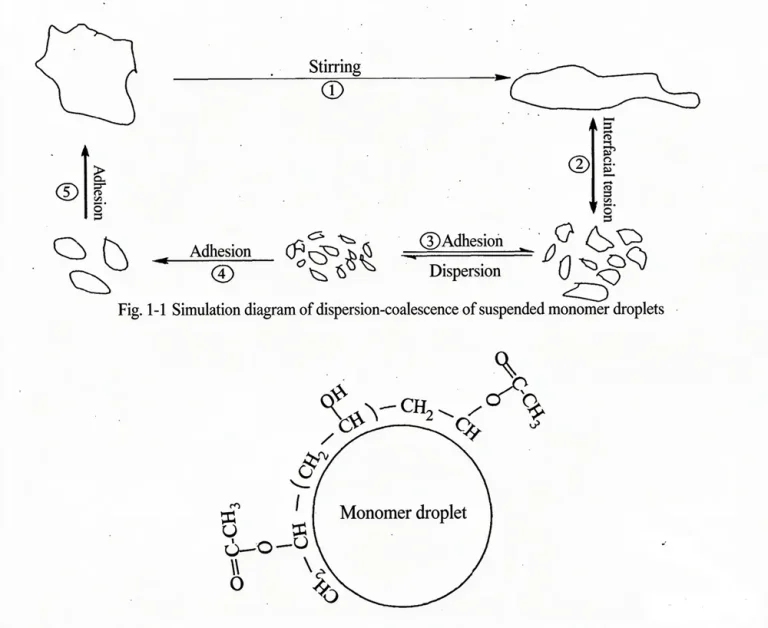
Taking polyvinyl alcohol (PVA) as an example, the hydrophobic ends of its molecular chains are anchored to the surface of the dispersed phase, whilst the hydrophilic hydroxyl groups extend into the aqueous phase, forming a dense hydrated layer. When two dispersed particles approach one another, this hydrated film generates strong penetrative repulsive forces due to spatial compression, thereby forcibly pushing the particles apart— —this is precisely the typical physical mechanism by which non-ionic polymeric dispersants achieve stable dispersion through steric hindrance effects.
Below is a schematic diagram illustrating the dispersion mechanism and the dispersing and protective functions of the dispersant:
Degree of alcoholysis = hydrophilic/hydrophobic equilibrium → determines ‘whether firm adsorption is possible’
The degree of alcoholysis determines the ratio of hydrophobic acetyl groups to hydrophilic hydroxyl groups on the molecular chain. Partially alcoholised types (87–89 per cent) possess a sufficient number of acetyl groups to anchor firmly within the interior of hydrophobic phenolic droplets, whilst the hydroxyl groups extend into the aqueous phase to form a hydration film. If the alcoholisation degree is too high (>98 per cent), the molecules become excessively hydrophilic, making it difficult to anchor effectively onto oily droplets; consequently, the dispersing effect deteriorates.
Degree of polymerisation = molecular chain length → controls ‘the thickness of the adsorption layer’
The degree of polymerisation directly determines the thickness of the interfacial adsorption layer and the strength of the interfacial film. A high degree of polymerisation forms a thick, robust protective layer, providing greater steric hindrance and enhancing the droplets’ resistance to agglomeration; however, an excessively high degree may have the opposite effect due to excessive viscosity in the aqueous phase or intermolecular cross-linking. Low polymerisation degree results in a thin protective layer, but one that migrates rapidly, making it suitable for auxiliary dispersion.
Polyvinyl alcohol is a polymer composed of hydrophilic and hydrophobic segments. In suspension polymerisation, it spontaneously adsorbs onto the interface of the system; for example, in the suspension polymerisation of PVC, the hydrophilic segments extend into the aqueous phase, whilst the hydrophobic segments extend into the oil phase containing vinyl chloride monomer and arrange themselves in an oriented manner, forming a protective film on the surfaces of vinyl chloride monomer droplets and polymer particles, thereby preventing aggregation between monomers or small particles.
Evaluation of Dispersion Performance and Product Selection
The evaluation of dispersion properties is carried out using a sedimentation and stratification test. Trichloroethylene is used to simulate vinyl chloride, and this is mixed with an aqueous solution of the dispersant and poured into a graduated test tube. The mixture is agitated in a shaker for a specified period; after standing, the relationship between the volumes of the dispersion, the intermediate dispersion layer and the monomer—the three layers—over time is observed. The degree of dispersion can be calculated using the following formula. The higher the value of f, the better the dispersion.
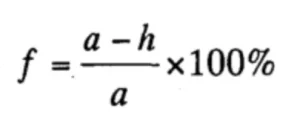
f: degree of dispersion; a: height of the dispersion system at the start of sedimentation; h: height of the liquid layers after sedimentation.
When selecting polyvinyl alcohol as a dispersant, the key considerations are controlling the degree of alcoholysis and the degree of polymerisation.
The degree of alcoholysis determines the hydrophilic/hydrophobic balance. Partially alcoholised types (85–90%) contain an appropriate amount of hydrophobic acetyl groups, enabling them to anchor firmly to hydrophobic surfaces (such as phenolic resin droplets or carbon materials); they offer high dispersion efficiency and are readily soluble. Fully alcoholised types (98–100%) are excessively hydrophilic, resulting in weak anchoring to oily surfaces; they are primarily used in suspension polymerisation systems requiring strong gel preservation.
The degree of polymerisation determines the thickness of the steric barrier layer. A high degree of polymerisation (1700–2600) forms a thick protective film with strong anti-agglomeration properties, making it suitable for suspension polymerisation of materials such as PVC; a medium to low degree of polymerisation (500–1700) results in rapid migration and easy elution, and is commonly used for the dispersion of nanopowders or as an auxiliary dispersant.
When carrying out chemical reactions, selecting the appropriate dispersant for the specific system, using the correct addition ratio and following the appropriate sequence of addition, is essential for achieving the desired material structure.