
pva knowledge
Excessive Secondary Hairs and Difficult Dry Splitting After PVA Sizing?
The "Secondary Hairs" Headache for Weaving Mills
In the sizing of fine-count polyester/cotton high-density fabrics, pure polyester fine-denier fabrics, and similar varieties, many weaving mills face a common problem: excessive secondary hairs and difficult dry splitting. After the sized yarn leaves the drying cylinder, the surface hairs are not effectively laid down; instead, a large number of “regenerated hairs” are generated during the splitting process, seriously affecting subsequent weaving efficiency and fabric quality. Statistics show that 70% to 80% of the factors affecting air-jet loom efficiency are related to yarn hairiness.
Where does the problem lie? Extensive practice indicates that excessively high PVA content is one of the core causes of secondary hairs and difficult splitting. Although PVA has excellent adhesion and film-forming properties, its film strength is too high, resulting in high resistance during dry splitting. The film is forcibly torn during splitting, producing large amounts of harmful secondary hairs.
So, how can we solve this problem while ensuring sizing quality? This article starts with a comparison of PVA-1799 and PVA-0588 and offers systematic formulation optimisation recommendations.
Why Does PVA Cause "Secondary Hairs"?
To solve the problem, we must first understand the mechanism.
PVA 1799 is a fully hydrolysed type, with a hydrolysis degree of 99% or higher and a polymerisation degree of about 1,700. Its characteristics are: a high number of hydroxyl groups on the molecular chain, strong intermolecular hydrogen bonding, leading to high film strength, hardness, and abrasion resistance. However, these advantages become disadvantages during dry splitting – the film is too “rigid”, cannot be peeled off smoothly, and is forcibly torn, producing many hairs.
In addition, high-concentration PVA size has relatively high viscosity and poor fluidity, reducing its penetration into the yarn. The film stays more on the yarn surface as “coating” rather than “penetration”, further aggravating film tearing during splitting.
When the traditional formulation contains too much PVA 1799, the above problems become particularly prominent.
PVA-1799 vs. PVA-0588: Key Differences
PVA 1799 has a polymerisation degree of about 1,700 (high), a hydrolysis degree of 99% or above (fully hydrolysed), and requires hot water above 85°C to dissolve. Its film is strong, hard, and abrasion resistant, but its water solubility is poor and penetration is limited.
In contrast, PVA 0588 has a polymerisation degree of about 500 (low), a hydrolysis degree of about 88% (partially hydrolysed), and can dissolve in cold water. Its film is flexible and elastic, with good water solubility and better penetration into yarn.
Regarding adhesion to fibres, PVA 1799 adheres better to hydrophobic fibres like polyester, while PVA 0588 has a stronger affinity for hydrophilic fibres like cotton. For desizing, PVA 1799 is more difficult to remove and leads to higher COD in effluent, whereas PVA 0588 is easily desized and imposes a lower environmental burden.
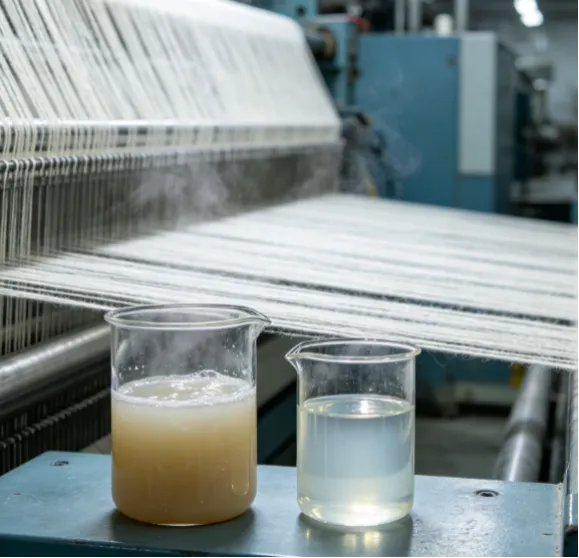
Formulation Optimisation: The "Golden Ratio" of 1799 and 0588
For fine-count polyester/cotton high-density fabrics, the following formulation adjustment is recommended.
The traditional problematic formulation typically uses PVA 1799 as more than 60% of the main size, with only small amounts of modified starch and acrylic size. This often results in excessive secondary hairs and difficult splitting.
The recommended optimised formulation is: reduce PVA 1799 to 30%–40% of the main size; introduce 10%–20% of PVA-0588; add 40%–50% of modified starch (e.g., phosphate starch); and include an appropriate amount of lubricant or softener. With this adjustment, the film achieves a good balance between integrity and flexibility, splitting becomes smooth, and secondary hairs are significantly reduced.
In a practical case for pure polyester fine-denier fabric, using the combination of PVA-1799 and PVA-0588 together with a polyester sizing agent (JL polyester size) significantly reduced size induced sticking and regenerated hairs, improved shed clarity, and achieved a weaving efficiency of 86.7% on 1511M looms. Other studies show that PVA 0588 can partially replace PVA 1799, and after comprehensive evaluation of size properties, adhesion to polyester/cotton roving, and sized yarn performance, this substitution not only reduces environmental pollution but also improves sizing quality.
Process adjustments: appropriately lower the size concentration and total PVA amount to enhance penetration; avoid excessive sizing pick up that leads to overly thick films; control drying cylinder temperature to prevent the film from becoming too brittle; and keep splitting zone tension moderate to reduce tearing force.
Conclusion
The problem of “secondary hairs and difficult splitting” is not unsolvable. By rationally combining PVA 1799 and PVA 0588, optimising the formulation ratio, and making appropriate process adjustments, you can maintain sizing strength while significantly reducing secondary hairs and improving weaving efficiency and fabric quality. The key is to shift from “relying solely on 1799” to “synergistic use of 1799 and 0588”.